


Thematic Images for Yule or Yuletide


Merry Yule
The present Yuletide (an archaic term for Christmas) winter season in North America started on the December 2026 Winter Solstice and ends on the March 2027 Vernal Equinox. The Winter Solstice is the time when the light is reborn from the darkness of the womb of Winter.
Yule or Yuletide ("Yule time") is an ancient Pagan indigenous midwinter festival (based on Norse mythology) observed by the historical Germanic peoples, later being absorbed into and equated with the Christian festival of Christmas. In modern Germanic language-speaking areas and some other Northern European countries, Yule denotes the Christmas holiday season. Some scholars believe that Yule, in one form or another, has been a Winter tradition for at least as long as paganism has been around; approximately 4,000 gears.The earliest references to Yule are in the form of month names, where the Yule-tide period lasts somewhere around two months in length, falling along the end of the modern calendar year between what is now mid-November and early January. The festivities of Yule are generally held to have centered on Midwinter (although specific dating is a matter of debate), and feasting, drinking, and sacrifice were involved. Yule is traditionally celebrated at the beginning of the Winter Solstice and ends at dusk on th1st day of the new year.
The Neopagans, who borrow from Germanic folklore and customs, also call the Winter Solstice season "Yule" or "Yuletide." In most forms of Wicca, this holiday is celebrated at the Winter Solstice ("Solstice Night") as the rebirth of the Great horned hunter god, who is oftentimes called the "Sun King" and is viewed as the newborn solstice Sun.


Thematic Images for Yule Greetings

.jpg)


.jpg)


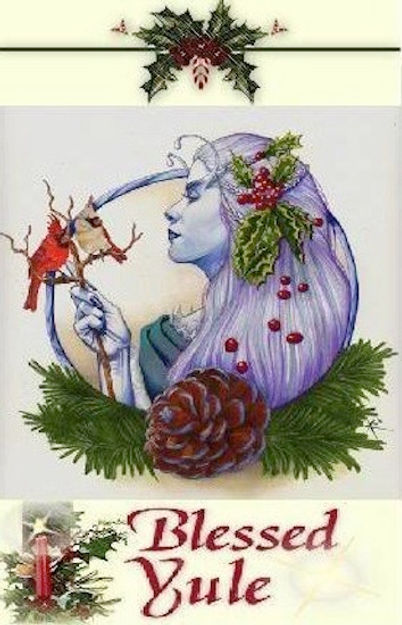


Thematic Images for Yuletide


Norse Yuletide rituals


Thematic Images for Yule Night, Longest Night of the Year

Yule/Winter Solstice Night


Yule/Winter Solstice Night ritual

Thematic Images for Yule Santa Claus & Father Christmas


Father Christmas

Father Christmas
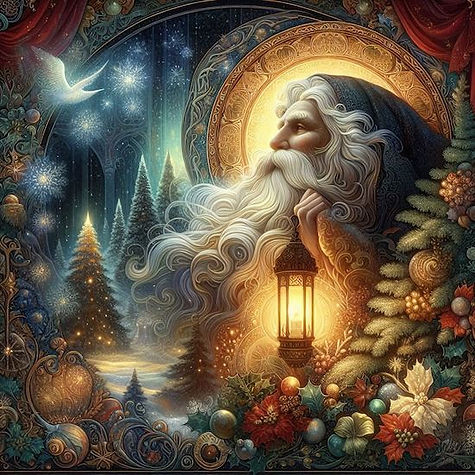
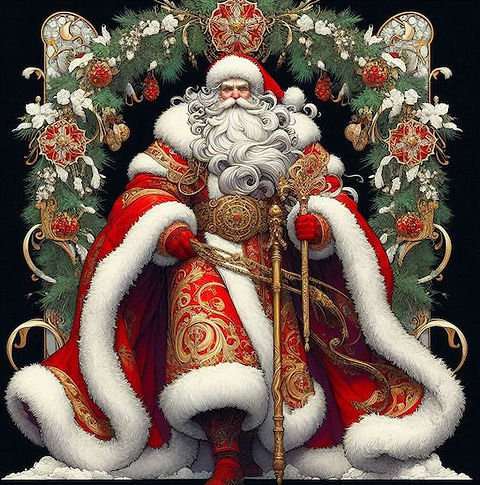

Father Christmas

Father Christmas


Thematic Images for Yule Holly King and Mistletoe King Santa Claus


Thematic Images for Yule Holly King


The folklore archetype of the Holly King is model for our modern Santa Claus.
Thematic Images for Holly, Ivy, Oak King and Queen


Holly King & Ivy Queen

Holly King & Queen

Holly King

Holly Queen


Yule Holly King & Ivy King

Yule Holly King and Ivy King
Thematic Images for Holly King & Oak King


Yule Holly King & Oak King
Yule Holly King & Oak King


Yule Holly King & Oak King
Yule Holly King & Oak King

The Holly King hands his crown to the Oak King
In the Northern Hemisphere, Yule marks the shortest day and the longest night,
signaling the end of the Holly King's reign and the beginning of the Oak King's dominion. This transition symbolizes hope and the return of light.
"Oak King and Queen" refers to figures in folklore representing seasonal cycles, often paired with the Holly King, symbolizing the battle between light/growth (Oak King, summer) and dark/dormancy (Holly King, winter).


Thematic Images for Yule Goddesses


Yule Holly Goddesses


Thematic Images for the Spirits of Yule


In Italian folklore and folk customs, La Befana is either pictured as a witch-like old woman (or sometimes a goddess figure), who delivers gifts to children throughout Italy on Epiphany Eve in a similar way to Santa Claus or the Three Magi. La Befana is a widespread Christmas tradition among Italians and thus has many names, one being Strenia in Sicily. La Befana's origin blends pagan Winter Solstice traditions with the Christian Epiphany story. La Befana was originally a pagan figure rooted in Roman winter festivals for Strenia and later Christianized.
Thematic Images for Neopagan Yule


Thematic Images for Celtic Yule/Christmas


Celtic Yule/Christmas Druid Father


Celtic Yule/Christmas Mummers & Morris Dancers

Mummers At Christmas in the Olden Time


Celtic "Hunting the Wren" Festival

Hunting the Wren

Embassy of Ireland Wrenboys in Malta
.jpg)
St. Stephens Day Wrenboys (December 26 in Dingle, Co Kerry)
"Hunt the Wren Day" also known as "Wren Day," "Wren's Day,"or "Day of the Wren," is celebrated on 26 December, St. Stephen's Day, in a number of countries across Europe. It is primarily a traditional custom carried out in Ireland called "Wren Day" (Irish Gaelic: Lá Fhéile Stiofáin or Lá an Dreoilín) and on the Isle of Man (Manx Gaelic: Shelg yn Dreean). Traditionally, men and boys hunted a wren, which was revered as the "king of the birds." They beat the bushes and hedges with sticks, and when a wren flew out they tried to down the bird by throwing sticks, stones and other objects at it. Whoever killed the wren was believed to have good luck for a year. They placed it on top of a staff decorated with holly, ivy and ribbons, or displayed it in a decorated box on top of a pole. This was paraded around the neighborhood by a group of "Wrenboys" (or "Droluns:" lucht an dreoilín) and "Mummers" (or "Strawboys"), who typically dressed in straw masks or suits, greenery and colorful motley clothing. They formed music bands, played songs, and paraded through towns and villages in exchange for donations. This was meant to ensure prosperity for the coming year. The people afterwards held a funeral for the wren and danced around the "wren pole" or "wren bush."
Like many traditional seasonal festivals, Wren Day gradually died out following industrialization, but the custom has been undergoing revival since the late 20th century (although the wren is no longer hunted and a stuffed wren is used instead). Wren Day has survived or been revived in a few towns and villages, mainly on the Isle of Man and in the southern parts of Ireland, such as in Dingle, County Kerry.
The Celtic "Green Man"


The Green Man of Yule/Christmas
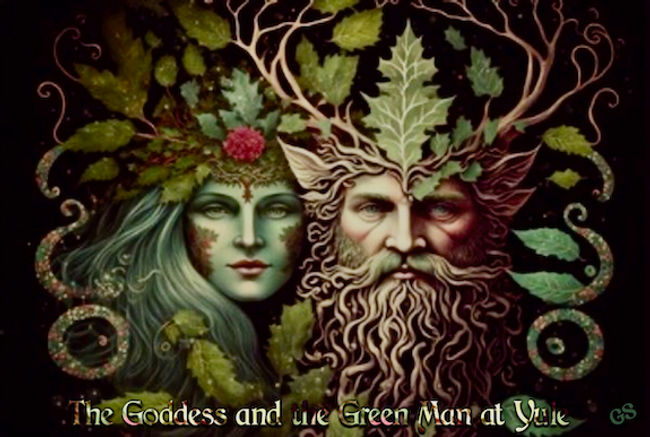
The Green Man is believed to symbolize the cycle of life, death and rebirth. The symbol of Godhood within the male and its relationship with the transcendent life force of the Goddess, the female expression of divinity. He is a Pagan symbol who heralds Spring after a long winter and the renewal of lush vegetation. The Green Man is a feature of much of the pastoral lore in the Celtic countries, including Great Britain and Ireland, where he's been a constant for thousands of years. (He can even be seen on many Gothic cathedrals among the gargoyles.) The Green Man also appears in during Winter Solstice and Yule as another form of the traditional holly, ivy, and oak kings.


Thematic Images for Traditional Christmas Greetings

"Happy Christmas to you" (Irish Gaelic)

.png)
.png)


Star of Wonder
Thematic Images for the Pagan Origins of Christmas
Thematic Images for the Pagan Dying-and-Reborn Sun/Son Gods
It is estimated that he rites of the Winter Solstice go back 25,000 years in the human past. These rituals had to do with the archaic worship of the rebirth of the sun at Winter Solstice. Thus the Winter Solstice was the turning point of time and the birthday of the sun, the moment of new beginnings. Winter Solstice observance of our ancient ancestors was a special time when the community could renew its connection with nature and its seasonal cycles; when people could come together and share in the great mystery of “the rebirth of the sun (or light) out of the womb of winter's darkness."
In Christian culture, this same great mystery became known as the birth of Jesus Christ, the birth of the "Light of the World;" Jesus "the true light." (Gospel of John). However, long before the birth of Jesus of Nazareth, the celebration of the return of the Midwinter sun held a central place in civilizations throughout the ancient world. It is now fairly well documented that many aspects of the Christmas tradition have their roots in pagan religion, notably Celtic and Roman religion and custom. Christmas, as the birth of the Son of God, was designed to replace the earlier pagan celebrations of the Winter Solstice, notably the rebirth of the sun. Thus, the Winter Solstice was overlaid with Christmas.
The seasonal connections with the pagan festivals of the Winter Solstice relate them to archaic times, when many of the earth’s inhabitants were sun worshipers. In later times, when the sun became personified, the worship was transferred to sun gods; to those solar deities who have come to be known as dying-and-reborn gods, such as Tummuz, Osiris, Horus, Dionysus, Adonis, and Attis.
The pre-Christian myths of the solar dying-and-reborn gods had them born at Midwinter, specifically at the Winter Solstice, which, according to the Roman Julian calendar, was approximately the 25th of December. (When Julius Caesar introduced the Julian calendar in 45 B.C.E., December 25th was approximately the date of the Winter Solstice. After the advent of the Gregorian calendar in 1582, the solstice falls on December 21st or 22nd.) This date was the birthday of the solar savior deities such as Sol Invictus (the "Unconquered Sun"), Mithras, and Dionysus-Bacchus.
Therefore, behind the Christian sacred event of the birth of the Son of God, is the older births of the pagan dying-and-reborn Sun gods.


Modern depictions of the ancient Roman Sol Invictus
Dies Natalis Solis Invicti
The Roman festival that celebrated the birthday of Sol Invictus (the Unconquered Sun), the sun god, on December 25th of the Julian calendar. Sol Invictus was the main divinity of the Roman pantheon. (The epithet, Sol Invictus had been utilized for several Roman solar deities from the 3rd century B.C.E. Before this time, there was the Roman sun god "Helios" or "Sol.")


Sol was the solar deity in Ancient Roman religion. It was long thought that Rome actually had two different, consecutive sun gods. The first, Sol Indiges, was thought to have been unimportant, disappearing altogether at an early period. Only in the late Roman Empire, scholars argued, did solar cult re-appear with the arrival in Rome of the Syrian Sol Invictus, perhaps under the influence of the Mithraic mysteries. (Mithras, born on December 25th, was the savior god of the greatest and most popular religious cult in Rome before the coming of the Christian cult and became its main rival.) Today, SOL is still the main word for sun in Romance languages. SOL is used in contemporary English by astronomers and many science fiction authors as the proper name of the Sun to distinguish it from other stars which may have their own planetary systems.


Christus Helios, the vault mosaic ceiling detail of Sol in Mausoleum M, of the Julii, which is interpreted as Christ-Sol (Christ as the Sun). Representation of Christ as the sun-god Helios or Sol Invictus riding in his chariot. Early Christian and pagan beliefs are combined in this third-century mosaic of Christ as a sun-god.
.jpg)
Jesus depicted as the sun is a common motif in Christian art. In this artwork, from late 15th-century Germany, the Christ child and Virgin Mary are surrounded by billowing rays of sun. "The Crowned Virgin and Child as The Apocalyptic Woman Clothed in the Sun." (Germany, late 15th century illustration.)
Pagan Dying & Reborn Sun Gods

Mithras as Sol Invictus
Mithraism, also known as the Mithraic mysteries or the Cult of Mithras, was a Roman mystery religion centered on the bull-slaying god Mithras. Although inspired by Iranian worship of the Zoroastrian divinity (yazata) Mithra, the Roman Mithras was linked to a new and distinctive imagery, and the level of continuity between Persian and Greco-Roman practice remains debatable. The mysteries were popular among the Imperial Roman army from the 1st to the 4th century CE.
Numerous archaeological finds, including meeting places, monuments, and artifacts, have contributed to modern knowledge about Mithraism throughout the Roman Empire. It has been theorized that Mithraism was the pagan belief system that shaped the Christian world. (Recent research has shown that an astronomical code based upon astrological cycles of the Zodiac was the central secret of the Mithraic mysteries, one which consisted of an ancient vision of the ultimate nature of the universe.) The iconic scenes of Mithras show him being born from a rock, slaughtering a bull (the tauroctony), and sharing a banquet with the god Sol (the Sun).


Saturnalia, the Predecessor of the Twelfth Night of Christmas


Saturnalia
Many of the wintertime customs in Western Europe descended from the ancient Romans. The primary one from which the Christmas season descended was Saturnalia, an ancient Roman holiday celebrated at the Winter Solstice. This was a public holiday each year from December 17th to the 24th. It honored Saturn, the god of the harvest. The Romans believed that their harvest deity, Saturn, had ruled the land during an earlier age of rich crops, and so celebrated the Winter Solstice on Saturn’s promise of the return of the sun with a Saturnalia. This was high festival of public rites, gift-giving, role reversals, and a general mood of revelry and licentiousness. (The role reversals of Saturnalia, such as masters and slaves switching places, becomes a recurring pattern in later European seasonal festivals of "social inversion," popularly known as "turning the world upside-down.") Riotous merrymaking took place, and the halls of houses were decked with boughs of laurel and evergreen trees. What had originated as a feast day later expanded into a weeklong festival full of music, dancing, banquets, drinking, games, and bonfires. The customary greeting for the occasion was “Io, Saturnalia!” (io, pronounced “yo,” being a Latin interjection related to “ho,” as in “Ho, praise to Saturn”).


Thematic Images for the Twelve Days of Christmas & the Twelfth Night

The Twelve Days Of Christmas, Christmastide, & The New Year:
"Joy and Mirth Are Now to Reign"
The Twelve Days Of Christmas are probably the most misunderstood part of the church year among Christians who are not part of liturgical church traditions. Contrary to much popular belief, these are not the twelve days before Christmas, but in most of the Western Church are the twelve days from Christmas until the beginning of January 6th (the 12 days count from December 25th until January 5th), with January 6th being a "thirteenth day" in some traditions and languages. In some traditions, the first day of Christmas begins on the evening of December 25th with the following day considered the First Day of Christmas (December 26th). In these traditions, the twelve days begin December 26th and include the Epiphany on January 6th. January 6th is also sometimes considered Twelfth Day/Twelfth Night with the Twelve Days of Christmas actually after Christmas Day from December 26th to January 6th. For many Christian denominations (e.g., the Anglican Communion and Lutheran Church) the Twelve Days are identical to Christmastide, but for others (e.g., the Roman Catholic Church) Christmastide lasts longer than the Twelve Days of Christmas.
The origin and counting of the Twelve Days is complicated, and is related to differences in calendars, church traditions, and ways to observe this holy day in various cultures. In the Western church, Epiphany is usually celebrated as the time the Wise Men or Magi arrived to present gifts to the Christ child. Traditionally there were three Magi, probably from the fact of three gifts, even though the biblical narrative never says how many Magi came.
In some cultures, especially Hispanic and Latin American culture, January 6th is observed as Three Kings Day, or simply the Day of the Kings. Even though December 25th is celebrated as Christmas in these cultures, January 6th is often the day for giving gifts. In some places it is traditional to give Christmas gifts for each of the Twelve Days of Christmas (hence the popular song). Since Eastern Orthodox traditions use a different religious calendar, they celebrate Christmas on January 7th and observe Epiphany or Theophany on January 19th.
By the 16th century, some European and Scandinavian cultures had combined the Twelve Days Of Christmas with (sometimes pagan) festivals celebrating the changing of the year. These were usually associated with driving away evil spirits for the start of the new year.
In the Elizabethan period, "Twelfth Night" was a festival celebrated with music, masked balls, misrule and general revelry. The Twelfth Night is January 5th, the last day of the Christmas Season before Epiphany (January 6th). In some church traditions, January 5th is considered the eleventh Day of Christmas, while the evening of January 5th is still counted as the Twelfth Night, the beginning of the Twelfth day of Christmas the following day. Many European celebrations of Twelfth Night included a King’s Cake, remembering the visit of the Three Magi, and ale or wine. (A King’s Cake is part of the observance of Mardi Gras in French Catholic culture of the Southern USA.) In some cultures, the King’s Cake was part of the celebration of the day of Epiphany.
Twelfth Night in European traditions often meant riotous merrymaking, which included continuous feasting, music, and the election of a "Lord (or King) of Misrule" (a custom that is probably a survival from older pagan customs, including the Germanic Yuletide and the Roman Saturnalia, where the social order was "turned upside-down"). The entire merrymaking company was often known as the "Lord of Misrule & the Twelfth Night Revelers."


.jpg)


These illustrations (above) of the Twelfth Night Revelers are by Charles Briton (1871). Founded in 1870, the Twelfth Night Revelers are the second oldest carnival krewe. (Krewe: social organization that plans and stages parades, balls, and events for Carnival season, most famously Mardi Gras in New Orleans.) They are amongst the earliest that have survived of Mardi Gras parade designs.


Aion, god of the ages with zodiac
Kore, The Maiden
Kore & Aion of the Twelfth Night
(Picture: "Aion, god of the ages, in a celestial sphere decorated with zodiacal signs, between a green and a dismantled tree, representing summer and winter. Before him is the mother-earth Tellus, the Roman Gaia, with four children, the four seasons personified.)
Aion or Aeon was a Hellenistic deity associated with time itself; time unbounded or infinte (as in our word eon; time in the sense of ages). He was imagined as an orb or circle encompassing the universe. He was thus a god of ages, a cosmic deity.
Aeon is meintioned in a second-century descrption (by the Christian writer Epiphanius) of the celebration that took place on the night of January 5th/6th (the "Twelfth Night"), at which time there was a great festival. It was in honor of the mystery of the midwinter birth of the savior sun-god (as annually observed in Rome).
“They stay up the, whole night singing songs and playing the flute, offering these to the images of the gods; and, when the revelries of the night are over, after cock-crow, they go down with torches into a subterranean sanctuary and briny up a carved wooden image, which is laid naked on a litter. On its forehead it has the sign of the Cross, in gold, and on both its hands two other signs of the same shape, and two more on its knees; and the five signs are all fashioned in gold. They carry this carved image seven times around the middle of the temple precincts, to the sound of flutes and tambourines and hymns, and after the procession they carry it down again into the crypt. But if you ask them what this mysterious performance means they answer: Today, at this hour, the Kore, that is to say the Virgin, has given birth to the Aeon.”
What the Christian writer interprets as "Virgin" is a misnomer (not another "Virgin Mary"). Kore, or Persphone, was actually known as "The Maiden," who, along with her mother, Demeter (Earth Mother), was celebrated in the famous Hellenistic Eleusinian Mysteries.


Thematic Images for the Shamanic Origins of Santa Claus
& Christmas As An Amanita Muscaria Mushroom Festival
In the musical essay for Winter Solstice/Christmas, the Gypsy Scholar explores the shamanic origins of Santa Claus by suggesting that we can look to the northern shamans for the first appearance of the figure who, thousands of years later, evolved into the "jolly old elf" of Christmas. Thus, the GS contends, based upon his research, that if we also look at some of the parallels and similarities between shamans and Santa Claus, we can catch a glimpse of the evolution of the hallucinogenic shaman-Santa.
A significant aspect of the shamanism practiced in the Northern polar regions was linked to the Amanita muscaria mushroom (fly agaric mushroom), known as "mukhomor" in the local language. This hallucinogenic mushroom is more widely accepted in the modern world as the Alice in Wonderland mushroom. It was held very sacred by these ancient northern people and was used by shamans and others for ceremonial and spiritual purposes, such as to commune with spirits or bring back treasures from the spirit world Amanita mushrooms range from brightly red and white to golden orange and yellow. They only grow beneath certain types of evergreen trees. But the amanita is highly poisonous to humans. However, the reindeer love these mushrooms and, once the toxic elements are filtered by their livers, the resultant urine contains the still intact psychoactive elements. The shamans drank the filtered urine and took flight to the spirit-world by climbing up the "World Tree."
Here's an outline of the theory of the psychedelic, shamanic origins of the Santa Claus legend: (1) The theory suggests that the modern Santa Claus figure is linked to ancient pre-Christian beliefs and Winter Solstice rituals practiced by Siberian shamans; (2) Reindeer in Siberia are known to enjoy eating these hallucinogenic mushrooms, which is suggested as the origin for stories of flying reindeer; (3) The Siberian shamans consumed the red-and-white Amanita muscaria mushroom (from reindeer urine) to achieve altered states of consciousness and, consequently, ecstatic flight; (4) The red and white colors of the mushroom are thought to be echoed in Santa's traditional costume.
"Santa is a modern counterpart of a shaman, who consumed mind-altering plants and fungi to commune with the spirit world . . . as the story goes, up until a few hundred years ago these practicing shamans or priests connected to the older traditions would collect Amanita muscaria (the Holy Mushroom), dry them, and then give them as gifts on the winter solstice." ~ Prof. John Rush (author of "Mushrooms in Christian Art" and professor of anthropology at Sierra College in Rocklin, California).
With this information in mind, the GS speculates that what we know of the Christmas festival was once an Amanita muscaria mushroom festival.
Ancient & Modern Comparisons of Arctic-Siberian Amanita Mushroom Shamans


Modern Renditions of Arctic-Siberian Amanita Mushroom Shamans


Terence McKenna on the Shamanic Origins Of Santa Claus
“An example of how a very ancient folkway can be incorporated into our culture without us even realizing it is provided by discussing Amanita muscaria. If you go to the Encyclopedia Britannica and you look up Santa Claus, they'll tell you that it has to do with St Nicholas and that it got started in the 11th century. But, when you look at the Santa Claus story, it's a perfect mythologem to analyze from this point of view, because look what's going on with Santa Claus. First of all, Santa Claus’s colors are red and white, the colors of the Amanita muscaria. For sure, Santa Claus lives at the North Pole. What does this mean mean? It means that Santa Claus lives at the Axis Mundi where Yggdrasil, the Magic World Ash of Welsh mythology, has taken root. Santa Claus flies! This is what shamans do. Santa Claus is the master of the reindeer, the animal most associated with the Amanita muscaria. Santa Claus is aided in his work by troops of elves! And what is the work of Santa Claus? To build toys for children. Remember the DMT thing, saying ‘look at this, look at this’? Well, those were off duty elves—clearly! And, so, here are all the motifs, and I believe that for children in our culture that all the Christer stuff is what not what Christmas is about. Christmas is about standing in front of the tree on Christmas morning with the gifts arrayed and the twinkling lights on. Well that tree is the tree that the Amanita muscaria forms its symbiotic relationship to. It’s always spruce or pine that it has a mycorrhizal relationship to. So the number of motifs relating Santa Claus to a cult of Amanita muscaria—there's almost nothing but relational motifs there, and yet if you suggest this to people they just back away in horror, you know!”


Arctic-Siberian Shaman's World Tree Journey


The links below go to websites that present information on the psychedelic origin of Santa Claus and Christmas. Many of these reference academics who promote the shamanic Amanita muscaria mushroom theory.
The link below by the Gypsy Scholar is a primer that contains the basic information on the theory of the shamanic Amanita mushroom origin of Santa Claus and Christmas.


Thematic Images for Amanita Muscaria Mushroom Santa Claus & Christmas
Amanita Muscaria Mushroom Santa Claus


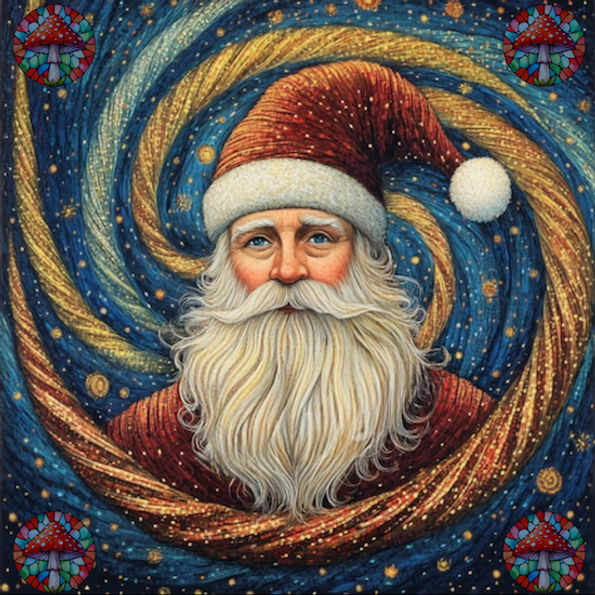


Psychedelic Santa Claus


Amanita Mushroom Christmas & Reindeer


Amanita Mushroom Christmas Witches


Amanita Mushroom Christmas/Yule Scenes & Decorations

.jpg)
Amanita Muscaria (Sobczyńska)


Amanita Mushroom Vintage Christmas Cards


Amanita Mushroom Christmas Ornaments


Amanita Mushrooms for Christmas


.jpg)
This giant Amanita muscaria mushroom (7-inches in diameter) was found in the Gypsy Scholar's backyard 2 years ago around the time of the Winter Solstice.
A Happy Psychedelic Christmas


Thematic Images of Jesus & His Psychedelic Mushroom Cult
(This webpage on the Amanita muscaria mushroom origin of Santa Claus and Christmas would not be complete without this section.)
Was Jesus the embodiment of a psychedelic mushroom and his religion a psychedelic mushroom cult?
Well, according to one scholar, John Allegro, the answer is YES indeed!
John Marco Allegro was a philologist, archeologist, and biblical scholar who studied the Dead Sea Scrolls. (Allegro was the sole humanist scholar to be granted access to the Essene scrolls. The outcome was his 1984 book, The Dead Sea Scrolls and the Christian Myth, wherein he took on the historicity of Jesus and and the role that the myths of the Essene community played in the development of Christianity. He argued that the ancient myths were misrepresented by the church as historical fact and suggested that information damaging to official church dogma has been intentionally suppressed.) In 1970, Allegro published a monograph entitled, The Sacred Mushroom and the Cross: A Study of the Nature and Origins of Christianity within the Fertility Cults of the Ancient Near East. He claimed that Jesus was actually a psychedelic mushroom and his religion was a mushroom cult.
“The Sacred Mushroom and the Cross: A Study of the Nature and Origins of Christianity Within the Fertility Cults of the Ancient Near East is a 1970 monograph by philologist John Marco Allegro. Allegro proposes an etymology driven reconstruction of biblical myth that treats Christian narratives as coded accounts of Near Eastern fertility cults that used psychoactive fungi in ritual. The thesis depicts Jesus as a mythological figure rather than a historical teacher. Publication sparked immediate controversy, prompted strong scholarly repudiation, and positioned the book as an enduring touchpoint in debates about psychedelics and religion.
Allegro connects lexical analysis with myth formation, asserting that many biblical names and motifs encode Sumerian roots tied to fertility-cult vocabulary. He maintains that a fertility cult built around ingesting visionary plants transmitted coded language into Hebrew and Greek scripture and identifies Amanita muscaria as the emblematic sacrament. Allegro extends the argument to visual evidence such as the Plaincourault Chapel Eden fresco and concludes that the gospel Jesus functions as a cultic personification created by early Christians under the influence of psychoactive mushroom extracts including psilocybin.
His unconventional claims quickly drew ridicule . . .” (Wikipedia)
Ridicule or not, the Gypsy Scholar will nevertheless (since he’s a long-time student of “Religion” and, thus, very much interested in the controversial debates about entheogens and religion) unapologetically present images from Allegro's book and other images pertaining to its crazy thesis. After all, in the GS's humble opinion, the idea that Jesus' mission was fueled by a psychedelic is actually no crazier than many of the official beliefs/dogmas of Christianity, from the gigantic cult of the Catholic Church to the smaller cult of the Mormons! (Speaking of which, there's even an intriguing theory that the origin of Mormonism was due to pyschedelics. See link below.)
Actually, Allegro's book is more than just Jesus and the sacred mushroom Amanita muscaria. It's a book about the history of psychedelics and religion that culminates with the Jesus mushroom cult. As the title indicates, it starts out in the Near East, specifically Sumer. Consequently, book is much more complex than its critics give it credit for--one wonders how much of it they've actually read. And whether or not Allegro's thesis about the psychedelic mushroom origin of Christianity are correct, the fact is that the book has inspired generations of scholars to investigate the role psychedelic plants (entheogens) have played in religion; from Vedic religion, to Greek Mystery Religions, to shamanic religions around the world. (Fun fact: more than 30 hallucinogenic plants are listed in the Holy Bible as being used in rituals all over the world to see into the spirit world.) The GS thinks of Terence McKenna here. His book, Food of the Gods, also claims that the fruit which Adam and Eve ate from was a symbol for a psychedelic mushroom since it gave them “knowledge.” However, as opposed to Allegro identifying the psychedelic mushroom as Amanita muscaria, McKenna identifies it as the psilocybin mushroom Psilocybe cubensis.)
In any case, while recognizing that this controversial mushroom Jesus theory is still in the realm of speculation, GS presents Jesus and the psychedelic mushroom imagery here (many discovered in European churches hidden in plain sight), since, if nothing else, these images are immensely entertaining!
The following quotation serves as an introduction to the images presented here:
“This presentation highlights unique research into the connection between psychedelics and the history of Christianity, based on photographs of hallucinogenic mushrooms discovered in churches and cathedrals across Europe and the Middle East. In early and medieval Christian art: in bronze castings, frescoes, mosaics, illuminated manuscripts, and stained-glass windows. They integrated ethnobotany, art history, church history, and anthropological fieldwork using an interdisciplinary study methodology. They discovered strong iconographic evidence of psychedelics in Christian art at a variety of religious locations, including isolated cave churches in Turkey, high holy places in England and Germany, restored ancient buildings in Italy, and little parish chapels in France.” ~Malik Bade, The Matrix & The Forbidden Knowledge

%201.jpg)
%202.jpg)
_j.jpg)
In his book The Sacred Mushroom and the Cross (1970), John Marco Allegro claimed that a 13th-century CE fresco, “Garden of Eden’s Tree of the Knowledge of Good and Evil,” located in the Plaincourault Chapel in Mérigny, France, provided evidence of the persistence in Christian Europe of an underground sacred mushroom sect, led by Jesus, that had survived since New Testament times.
Illustrations of Sacred Mushrooms in Early Christian Iconography
.jpg)
"God Creates Plants" (Canterbury Cathedral, England ca. 1180) God/Jesus is encircled with Amanita Muscaria, Psilocybe Cubensis and two other varieties.
.jpg)
God/Jesus creating the world (Great Canterbury Psalter, an illuminated MS miniature, Benedictine monastery Canterbury, England ca. 1200)


Modern Renditions of Jesus, the Sacred Mushroom Messiah


Some Popular Books On The Psychedelic Origin of Christianity


click images to expand
The Gypsy Scholar wishes you all . . .


click on image to go to the "New Year's" webpage