The Sixties and the Heretical Idea in Political Theory:
Popular Culture Can Be a Catalyst for Political Change


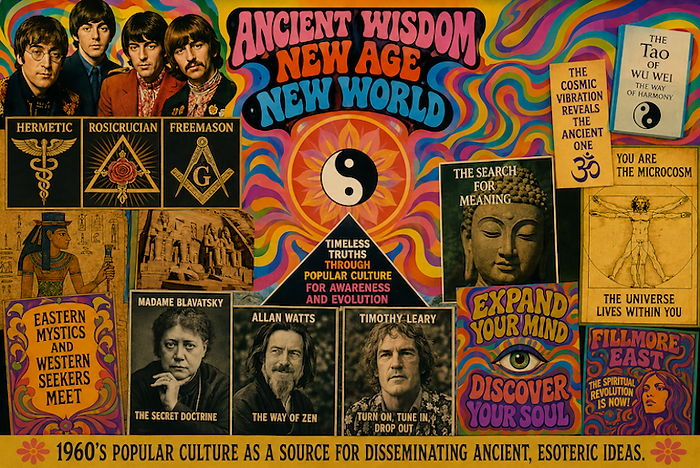
The artwork suggests the role of music in inspiring social change and unifying people. It also presents the idea that music can be a powerful tool for protest and social commentary.
Politics Follows Culture: Popular Culture As Catalyst For Political Change
The idea that popular culture can serve as a catalyst for political change came to the Gypsy Scholar when he researched the May Day festivals in both pagan and Christian Europe. In traditional European popular culture, the most important kind of setting was that of the festival, and the May Day festival or carnival was the epitome of popular culture.
When such festivals exhibit an overall transgressive behavior towards the oppressive rules of a society on the part of common people, then the term carnivalesque is used to identify such festivals or carnivals. Historically speaking, carnivalesque festivals were used to overturn traditional hierarchies and mix the culture of high authorities with those of the lower, profane; which “allows for alternative voices” that could change culture and politics. It is said that “carnivalesque imagery destroys conventional assumptions, offering women as well as men, the people as well as the bourgeoisie, the opportunity to manipulate the webs of meaning and systems of power.” This carnivalesque element in the May Day festivals resulted in what was popularly called “the world turned upside-down” (what social historians term “rituals of social inversion”). The popularity of this term carnivalesque owes much to the influence of the late Russian philosopher and literary critic Mikhail Bakhtin, who coined it in 1929 and again in 1965. His exuberant descriptions of the festive life of the Middle Ages have led scholars to explore how popular culture might work as a force for political change.
Although it is typically assumed that the relationship between medieval or premodern carnivalesque festivals or carnivals and political action is at best tenuous, carnivalesque historians Peter and Allon White turned this notion upside-down:
“It is in fact striking how frequently violent social clashes apparently ‘coincided’ with carnival … to call it a ‘coincidence’ of social revolt and carnival is deeply misleading, for … it was only in the late 18th and early 19th centuries—and then only in certain areas—that one can reasonably talk of popular politics dissociated from the carnivalesque at all.”
(The Politics and Poetics of Transgression, 1986. My emphasis.)
Thematic Images About Popular Culture
.jpg)

American Popular Culture

Global Popular Culture
%20down%20the%20track%20meme.png)
FM Radio as Popular Culture medium
- The Gypsy Scholar's "Tower of Song"
Some info memes on Popular Culture


Some books on Popular Culture